- Free Sample
- Request Quote
 (888) 868-2900 |
 - ITAR Registered
-

-

-

(888) 868-2900 |
Every flight-critical part carries a cycle-life number — and machining, stamping, grinding, and EDM leave behind exactly the surface anomalies that cut it short. Microburrs, embedded contaminants, tool marks, and recast layers become the initiation sites where fatigue cracks start and corrosion takes hold.
Able Electropolishing has spent decades finishing components for commercial and military aircraft manufacturers, rotorcraft OEMs, engine builders, landing gear suppliers, hydraulic and fuel system OEMs, and aerospace fastener producers. Our AS9100:2016-certified process removes a microscopically controlled surface layer, eliminating the defects that mechanical finishing leaves behind — while improving Ra up to 50% in a single step.
The result: measurably longer fatigue life, superior corrosion resistance, reliable penetrant inspection, and reduced friction on the parts where cycle-life specifications are non-negotiable.

Machining and EDM leave surface defects that electropolishing removes with microscopic precision
Prove it on your own part. Send us a sample and we’ll electropolish it free — processed on production equipment, returned with Ra data in 24–48 hours.
Thousands of pressurization cycles, extreme temperature swings, and decades of service between overhauls — aerospace hardware fails at the surface first. Here’s what electropolishing does about it.
Fatigue cracks initiate at surface stress risers — tool marks, microcracks, burr roots. Removing them electrochemically measurably extends cycle life on rotating and pressurized hardware.
Engine Hardware · Rotor Systems · Landing GearWire and sinker EDM leave a brittle, microcracked recast layer on cooling holes, injector features, and intricate geometries. Electropolishing strips it uniformly, controlled to ±.0002″.
Cooling Holes · Fuel Nozzles · BlisksMachining smear seals surface-breaking defects away from FPI penetrant. Removing .0002″–.0005″ per surface restores true indication visibility on fracture-critical parts.
FPI · DPI · Fracture-Critical HardwareCondensation cycling, de-icing fluid, and coastal operations attack contaminated surfaces. A chromium-enriched passive layer delivers up to 30× the corrosion resistance of passivation alone.
Airframe Hardware · Fasteners · FittingsA single detached microburr becomes contamination in a 3,000-psi hydraulic system. Electropolishing dissolves burrs at the root on manifolds, spools, and fittings — no mechanical contact, no new debris.
Manifolds · Servo Valves · Fuel FittingsHeat treatment leaves an oxygen-enriched alpha case that embrittles titanium surfaces. Electropolishing removes it uniformly, restoring the fatigue performance the alloy was specified for.
Ti 6Al-4V · Airframe · Engine MountsAcid pickling and plating drive hydrogen into high-strength steels. Electropolishing is anodic — oxygen evolves at the part surface — making it safe for 300M, 4340, and PH-grade hardware without bake-out.
Landing Gear · 300M · PH StainlessThread burrs scatter preload and invite galling. Able’s automation-enhanced bulk EP finishes high-volume aerospace fasteners with consistent thread-root quality, lot after lot.
A286 · Inconel · Ti FastenersInconel, Hastelloy, and Haynes components in hot sections and exhaust paths benefit from contamination-free, oxide-free surfaces that resist high-temperature corrosion and thermal fatigue.
Inconel 718 · Exhaust · BellowsSurface preparation for the environments that define aerospace duty cycles.
Tens of thousands of ground-air-ground cycles loading every structural surface.
−60°F at altitude to 1,800°F+ in the hot section — every flight.
Skydrol, jet fuel, de-icing glycol, and runway salts attacking exposed hardware.
Parts must inspect clean and perform to spec across 20–30 year service lives.
When a print calls for passivation, you’re choosing between nitric, citric, or electropolishing followed by passivation. All three are available in-house at Able. For fatigue-rated aerospace hardware, EP + passivation is the strongest specification — it removes the defects passivation can only clean around.
Pickling still shows up in aerospace — titanium descaling after heat treatment, exhaust and duct weldments, and mill-prepped stock. Here’s how the three process classes compare on flight-critical criteria, including the hydrogen embrittlement risk pickling carries on landing gear steels like 4340 and 300M and on PH grades.
| Criterion | Pickling | Passivation | Electropolishing |
|---|---|---|---|
| Removes base material | Aggressive / uneven etch | No | Microscopically precise (±.0001″–.0005″) |
| Removes burrs & microcracks | Partial | No | Yes |
| Surface roughness (Ra) | Roughens & etches | No change | Improves up to 50% |
| Weld heat tint & oxide scale | Yes — but uncontrolled | No | Yes — down to clean base metal |
| Improves fatigue life | No | No | Yes |
| Corrosion resistance | Can pit if uncontrolled | Improves | Up to 30× vs. passivation alone |
| Hydrogen embrittlement risk | Yes — high-strength & high-carbon steels | Low | None — anodic process |
| Leaves part passivated | No | Yes | Yes |
| Process consistency | Bath weakens with age | Good | Controlled & repeatable |
| Alloy compatibility | Too corrosive for many alloys | Limited — flash attack risk on low Cr-Ni grades | 35+ alloy families |
Full details in our technical guide: Passivation, Pickling or Electropolishing — Which Metal Finishing Process Is Right for Your Parts? Available from our Learning Center.
Deep-dive references written for aerospace engineers specifying surface finishing.
Improving part lifecycle for commercial and military aircraft — fatigue life, cycle specifications, alloy guidance, and application examples.
Download GuideWhy electropolishing is the ideal pre-cleaning step for penetrant inspection of fracture-critical aerospace parts — and what smear does to indication reliability.
Download WhitepaperHow microscopically precise material removal outperforms mechanical deburring on precision parts — with consistent, repeatable results.
Download WhitepaperFrom the hot section to the wheel well, we finish the components that carry cycle-life requirements. Send us a print ›
Fuel nozzles, cooling-hole hardware, combustor parts, blisks, seals, and EDM’d features.
Struts, pins, bushings, torque links, and high-strength steel hardware — no H₂ embrittlement risk.
Manifolds, servo valve components, spools, actuator internals, and fittings.
Injector components, fuel controls, filters housings, and contamination-sensitive fittings.
Pitch links, swashplate components, rotor hub hardware, blade retention pins, and transmission gears — the highest-cycle fatigue parts on any aircraft.
Machined fittings, brackets, lugs, and titanium structural components.
Bolts, screws, pins, and collars in A286, Inconel, and titanium — bulk EP capability.
Ball screws, gears, linkage hardware, and precision motion components.
Bellows, ducting, heat shields, and superalloy exhaust-path hardware.
Housings, chassis, connectors, and EMI-sensitive precision hardware.
Refurbished components requiring restored surface condition and re-passivation.
Propulsion, fuel system, and precision-machined components for unmanned aircraft programs.
Fracture-critical aerospace parts live and die by penetrant inspection — but machining and grinding smear metal across the very defects FPI is looking for. Electropolishing dissolves that smeared layer so the penetrant reaches real indications, not a false-clean surface.
AMS 2649 chemical etch is the traditional pre-FPI prep in aerospace NDT — but etching attacks grain boundaries, can drive hydrogen into high-strength alloys, and drifts with bath age. Electropolishing removes the same smeared layer with none of those liabilities.
| Factor | Chemical Etch (AMS 2649) | Electropolishing (ASTM B912) |
|---|---|---|
| Smear removal | Effective on work-hardened smear | Uniform dissolution of smear and surface peaks |
| Defect exposure | Opens crack mouths, but attacks base metal too | Opens crack mouths with no base-metal damage |
| Material removal control | Uneven, difficult to predict | Controlled to ±.0001″ per surface |
| Hydrogen embrittlement | Risk on PH grades, 4340, 300M — bake-out may be required | None — anodic process, no bake-out |
| Intergranular attack | Risk on sensitized material | None — dissolution uniform across grain structure |
| Post-prep surface | Matte, roughened — can trap penetrant and create false calls | Ra improved up to 50% — cleaner backgrounds, fewer false calls |
| Titanium alpha case | Partial, uneven removal | Complete, uniform removal |
| Repeatability | Sensitive to bath age and temperature | Current, time, and chemistry controlled — lot after lot |
| Best fit | Low-cost prep where dimensions and alloy allow | Fracture-critical and fatigue-rated hardware |
EDM is everywhere in modern aerospace manufacturing — cooling holes, fuel nozzle orifices, blisk features, seal slots. But the spark that cuts the feature also re-deposits molten metal as a recast layer: amorphous, brittle, and laced with microcracks that propagate under thermal and mechanical cycling.
Electropolishing dissolves the recast layer uniformly — material removal controlled to ±.0002″ — exposing sound base metal while preserving the tight tolerances the feature was cut to. On fatigue-rated hardware, that’s the difference between the recast layer’s crack initiation life and the base alloy’s.
Read: Eliminating EDM Recast Layer with Electropolishing ›Certificates of compliance ship with every order; process documentation supports first-article and PPAP-style submissions.
Internationally recognized aerospace quality management certification — the credential your supplier quality team looks for first.
Foundation quality system certification underpinning every process at our Chicago facility.
DDTC registration for military aircraft programs — controlled handling of defense articles and technical data.
Standard specification for passivation of stainless steels using electropolishing.
Aerospace passivation of corrosion-resistant steels — nitric and citric, all types and classes.
All processing at our Chicago, IL facility — nothing subcontracted offshore.
Search or filter the alloys behind airframes, engines, landing gear, and flight systems.
| Alloy | Category | Finish | Typical Aerospace Parts | Why It’s Specified | EP Benefit | Ra Before → After |
|---|
Able processes 35+ alloy families with proprietary recipes. Full alloy library at ableelectropolishing.com/alloys-electropolished.
Drawings reviewed against AMS, ASTM, and customer process specifications before any part is processed.
Machining oils, oxides, and handling contamination removed ahead of processing.
Alloy-specific recipe dissolves surface peaks, burrs, smear, and recast with controlled removal.
Where specified, nitric or citric passivation per AMS 2700 / ASTM A967 follows.
Ra verification, C of C, and lot traceability documentation with every shipment.
Yes — Able holds AS9100:2016 certification, the internationally recognized quality management standard for aerospace organizations, alongside ISO 9001:2015 and ISO 13485:2016. Our current certificate is available for download on our certifications page.
Fatigue cracks initiate at surface defects — tool marks, microburrs, microcracks, and inclusions act as stress concentrators. Electropolishing removes the defective surface layer electrochemically, without introducing new mechanical stress, leaving a smooth surface with dramatically fewer initiation sites. For cycle-limited aerospace hardware — rotor system components above all, where vibratory loads accumulate millions of cycles between overhauls — that translates directly into extended service life.
Yes. Able electropolishes titanium alloys including 6Al-4V (Grade 5) and CP grades. Electropolishing uniformly removes the oxygen-enriched alpha case layer left by heat treatment, restoring the surface fatigue properties of the base alloy. We also passivate titanium per ASTM F86.
No — this is one of electropolishing’s key advantages for landing gear and other ultra-high-strength steel hardware. Electropolishing is an anodic process: oxygen, not hydrogen, evolves at the part surface. Unlike acid pickling or plating, there is no hydrogen uptake and no bake-out requirement for 4340, 300M, or PH-grade parts.
Electropolishing:
Email a print to sales@ableelectropolishing.com for review of anything near these limits.
Standard delivery is 3 to 5 working days after receipt of order. Next-day and same-day expedite services are available for AOG situations — contact sales for options.
Yes. Able is ITAR registered and supports military aircraft, defense, and space programs from the same AS9100-certified facility. See our dedicated Space & Satellites page — and our Defense industry page — for program-specific details.
Send us your actual production parts. We process them on production equipment — not bench tests — and return them with Ra measurements and documentation you can put in a qualification package. Turnaround is 24–48 hours.
Tell us about your aerospace component and we’ll follow up within one business day.
ITAR-registered electropolishing for weapons systems, naval, missile, and ground vehicle hardware — with DFARS-supporting domestic sourcing.
Read more ›Surface finishing for launch vehicles, satellites, and spacecraft — vacuum-compatible cleanliness and NASA-referenced process standards.
Read more ›124+ alloys with finish documentation — stainless, titanium, superalloys, aluminum, and specialty steels.
Read more ›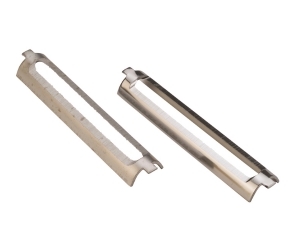
They may be microscopic, but the tiny jagged microburrs left behind on metal parts that have undergone machining processes can be big problems for manufacturers.
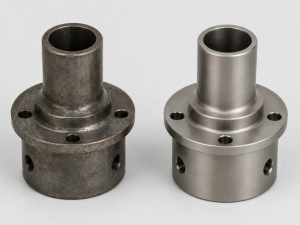
The extreme heat resistance and resilience characteristic of refractory metals like niobium, molybdenum, tungsten, tantalum and TZM make them useful in applications like aerospace components, small modular reactor components and other parts that must withstand extreme environments.
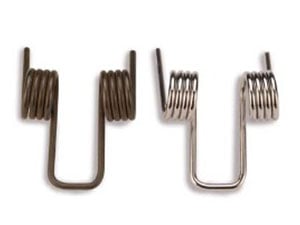
A wide array of modern assemblies for everything from aerospace parts to medical devices depend on high-quality springs that must perform to incredibly precise specifications, often in very tiny spaces.
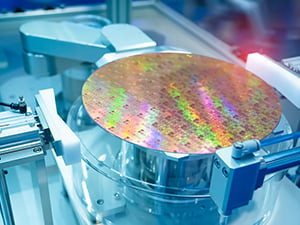
Electropolishing’s ability to remove a microscopically precise layer of surface material – with consistent and repeatable results – is a key reason it is so often specified as the final step in finishing metal parts for industries with no room for error.


