Alloy Electropolishing

200 & 300 Series Stainless Steel Electropolishing Service

The world's most widely used stainless steels β€” electropolished to deliver superior corrosion resistance, ultra-smooth microfinish, and bright chrome-like surfaces for medical, pharmaceutical, food, aerospace and industrial applications.

70+
Years Experience
30Γ—
Better vs Passivation
50%
Microfinish Improvement
#1
Largest EP Specialist

Companies around the worldΒ use Able Electropolishing’s services to enhance the functionality of their metal parts, including those made ofΒ 200 and 300 seriesΒ stainless steel. These austenitic alloys are known for excellent corrosion resistance, formability, and weldabilityβ€”making them the most widely used stainless steels across medical, pharmaceutical, food processing, and industrial applications.

Without electropolishing, stainless steel parts could have burrs and other surface defects that compromise performance. After undergoing electropolishing, 200 and 300 series components are left with aΒ bright, smooth and ultraclean finishΒ that greatly reduces the likelihood of corrosion, withΒ 30Γ— more corrosion resistance than passivation alone.

Electropolishing removes surface metal and embedded contaminants, including scale, rust, grinding compounds, foreign debris, and oils, creating a bright, uniform finish that does not peel or abrade. The process increases the chromium-to-iron ratio at the surface, enhancing passive layer formation for long-term durability.

Send us your 200 or 300 series stainless steel parts for a free evaluation. We’ll electropolish them at no costβ€”we’ll even pay for shipping. Samples processed and returned in a few days.

Key Benefits of Electropolishing for 200 & 300 Series Stainless Steel

Electropolishing delivers measurable, verifiable improvements to every metal surface β€” critical in an industry where a single contaminated part can destroy an entire wafer batch.

πŸ”¬

Micro-Burr Elimination

Machining leaves microscopic burrs that shed particles in cleanroom environments. Electropolishing removes them completely β€” eliminating a primary source of wafer contamination that passivation alone cannot address.

πŸ›‘οΈ

30Γ— Better Corrosion Resistance

Compared to passivation alone, electropolishing is 30 times more effective at improving corrosion resistance β€” creating a uniform passive oxide layer that withstands aggressive acids, solvents, and etchants.

✨

Ultra-Low Surface Roughness

Electropolished surfaces achieve Ra values as low as 4 Β΅in β€” far below standard machined finishes. Reduced surface area means fewer particle adhesion sites and dramatically improved cleanability between process runs.

βš—οΈ

Elevated Cr:Fe Ratio

Electropolishing enriches the surface chromium-to-iron ratio β€” meeting SEMI F19's minimum 1.5:1 Cr:Fe requirement and chromium oxide to iron oxide ratio of 2:1, verified through ESCA, Auger, and SEM analyses.

🌬️

Cleanroom-Ready Surfaces

Our electropolished surfaces meet Class 100 cleanroom requirements. Smooth, passive surfaces reduce outgassing and minimize particle generation β€” essential for sub-nanometer process nodes.

βš™οΈ

Dimensional Integrity

Electropolishing removes only microns of material uniformly across all surfaces. If planned during design, material removal can be factored into final size specifications β€” preserving tight tolerances while dramatically improving surface quality.

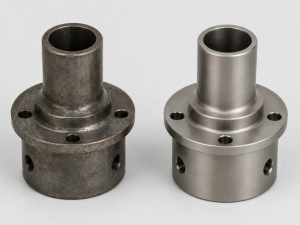
Electropolishing Results: 316 Stainless Steel

BEFORE EP
β†’
AFTER EP

316 Stainless Steel: Visual Finish

Excellent chrome-like finish after electropolishing. Dense Crβ‚‚O₃ passive layer delivers maximum corrosion resistance for medical, pharma, and semiconductor environments.

Before: 16–20 Β΅in RaAfter: 8–10 Β΅in Ra
SEM: BEFORE EP
SEM: AFTER EP

316 Stainless Steel: SEM Surface Topography (500Γ—)

Scanning electron microscopy reveals how electropolishing dissolves surface peaks and levels micro-valleys, eliminating machining marks, embedded contaminants, and crevices where corrosion initiates.

Rough: peaks, burrs, inclusionsSmooth: uniform passive layer

Electropolishing Stainless Steel: Before & After

Components We Electropolish in 200 & 300 Series Stainless Steel

Medical Devices & Implants

Surgical instruments, orthopedic implants, guidewires, and diagnostic components β€” electropolished for biocompatibility, cleanability, and compliance with ASTM F86 and ASTM B912.

Pharmaceutical & Biotech Equipment

Process vessels, fittings, tubing, and filling machine components β€” electropolished to ASME-BPE and ASTM B912 standards for pharmaceutical-grade surface finish and cleanability.

Food & Beverage Processing

Mixing tanks, conveyor components, blades, and contact surfaces β€” electropolished to FDA/USDA standards to resist bacterial adhesion and eliminate biofilm formation sites.

Semiconductor Manufacturing

Gas delivery systems, chamber components, and ultra-high-purity fittings β€” electropolished for sub-micron surface cleanliness and reduced particle generation in cleanroom environments.

Aerospace Components

Engine fasteners, hydraulic fittings, actuator housings, and structural hardware β€” electropolished per ASTM B912 for improved fatigue life and corrosion resistance.

Architectural & Decorative Hardware

Handrails, building facades, and consumer products β€” electropolished for a lasting bright finish that resists fingerprints, staining, and environmental degradation.

Chemical Processing Equipment

Reactors, heat exchangers, piping, and valve bodies β€” electropolished for improved flow characteristics, reduced product adhesion, and extended service life in corrosive media.

Hydraulics & Pneumatics

Cylinders, shafts, valve spools, and fittings β€” electropolished to reduce friction, prevent galling, improve sealing, and extend component life in high-cycle hydraulic and pneumatic systems.

Alloy Finish Results: 200 & 300 Series Stainless Steel

Expected finish quality from Able's electropolishing process based on our extensive production experience.

Alloy Able Finish Quality EP Benefit Typical Applications Ra Before β†’ After

Our Electropolishing Process

1

Part Evaluation

Alloy, geometry, and spec requirements assessed by our experts.

2

Cleaning & Prep

Oils, oxides, and contaminants removed. Custom racking designed.

3

Electropolishing

Proprietary electrolyte dissolves surface peaks. Crβ‚‚O₃ passive layer forms.

4

Passivation

Uniform corrosion-resistant oxide layer formed and verified if requested.

5

QC & Delivery

Inspected per specification, packed and shipped.

Contact us to learn more about 300 series stainless steel electropolishing

Learn About the Electropolishing Difference


Electropolishing 101 Webinar

Electropolishing 101
Webinar

Learn everything you need to know about electropolishing as part of a private, interactive webinar. Let us know your availability and your part issues and our electropolishing experts can get you on our schedule.

Schedule Your Private Webinar
Try Electropolishing for Free: Sample Request

Try Electropolishing for Free:
Sample Request

Send us your parts and we'll electropolish them for free – we'll even pay for the shipping! Samples are processed and returned in a few days.

Request a Sample

Medical Device Manufacturing

Medical Device Manufacturing

From implantable devices to surgical instruments, electropolishing is a single-process treatment that results in biocompatible, safe and ultra clean parts.

Learn More  

Aerospace

Aerospace

We offer aerospace vendors and original equipment manufacturers our signature metal finishing services to increase fatigue-resistance for their metal parts, rendering them capable of withstanding the stress and corrosion that comes with long-term use.

Learn More  

Pharmaceutical

Pharmaceutical

Our strict adherence to industry standards ensures that pharmaceutical components are electropolished in accordance with ASTM B912 and ASME BPE specifications. These products are clean and smooth, corrosion resistant and contaminant free.

Learn More  

Automotive

Automotive

Corrosion resistance and microfinish improvement are essential for critical automotive parts, making electropolishing an increasingly beneficial option for automakers.

Learn More  

Consumer Appliance

Consumer Appliance

Our metal finishing services help increase corrosion resistance for these parts, and by removing the outermost layer of metal with electropolishing the durability and longevity of these appliance components is increased.

Learn More  

Food & Beverage

Food & Beverage

Electropolishing materials for this industry eliminates the buildup of bacterial biofilms, as well as keeping the equipment free of contaminants like Salmonella. Electropolishing delivers the level of sanitation required by a number of regulatory agencies.

Learn More  

Hydraulics & Pneumatics

Hydraulics & Pneumatics

From robotics to mobile equipment, the uses of electropolishing in the hydraulics and pneumatics industry are many. By helping prevent premature part failure, electropolishing reduces downtime and increases the life cycle of these components.

Learn More  

Electronics

Electronics

Improving conductivity and performance is just one benefit electropolishing offers for electronics parts. The surface finish is improved by as much as 50%, removing imperfections from the material without material removal.

Learn More  

Electropolishing, Passivation and Metal Surface Analytics Blog

Why Manufacturers Use Electropolishing for Precision Metal Parts

Electropolishing is a precise and controllable process for eliminating defects from the surface of metal parts. But it’s not the only finishing process available to manufacturers; there are mechanical, chemical and plating processes that can remove defects and improve the…

High-Quality Electropolishing for Small and Intricate Parts

Metal fabrication for parts used in the medical and electronics industries can involve dimensions as small as a grain of rice β€” or even a strand of hair. At that scale, surface defects may be invisible to the naked eye,…

When is Stainless Steel Passivation Required?

While stainless steel is known for its corrosion resistance, it contains iron, which is susceptible to corrosion, especially if parts are frequently exposed to moisture or harsh environments. Contamination left behind by machining processes can also impede the corrosion resistance…

Electropolishing Specialist vs. a Local Metal Finishing Company

Electropolishing is a highly controlled electrochemical process that directly impacts surface integrity, corrosion resistance, cleanliness, and performance.