- Free Sample
- Request Quote
 (888) 868-2900 |
 - ITAR Registered
-

-

-

(888) 868-2900 |
Your interactive guide to the process, the benefits, and the results that matter for your parts and your industry.
Electropolishing combines and improves every step for consistent, repeatable results.
Choose the path that fits what you need today — a quick primer, the full plant walkthrough, or straight to the benefits that matter for your parts.
Different challenges. One powerful solution.
← → to step through categories · Esc to close
Working with a specific material? Type a grade or alloy — 316L, Ti-6Al-4V, 17-4, Inconel 718 — or pick a family to see what electropolishing delivers for it.
Send sample parts and we'll electropolish them free — shipping included — on production equipment in 24–48 hours.
Electropolishing is the last operation in most builds — which makes it the worst place to discover a problem. Finish First moves that conversation to the front: part review, samples, and a proven window before anything runs at volume.

How much surface material can be removed without affecting function — and the finish you want when it is gone.
±.0001″per surface. Microfinish improvement needs a minimum of .00025″ per surface.
Parts are racked and submerged, so contact points leave witness marks. Call out sharp edges, sealing faces, and any surface where appearance matters — we rack around them.
Name the standard on the drawing and in the quote request. Treat it as the guideline and the drawing as the part-specific requirement.
ASTM B912the most commonly used electropolishing specification.
A finish is only as good as it arrives. Specify packaging on the drawing — bulk through to clean-bench bagging — so the surface you paid for survives transit.
✓ Each of these traps solution or shields current. Caught at part review they are a drawing change; caught after production they are a scrap report.
| Alloy family | Length | Width | Height |
|---|---|---|---|
| 300 & 400 series stainless | 108″ | 41″ | 42″ |
| Copper, brass, aluminum | 72″ | 14″ | 17″ |
| Refractory metals | 26″ | 8.75″ | 9.75″ |
Both processes leave a part passive. Only one removes material — which is why one of them also deburrs, polishes and cleans while it is at it.
Deburred, polished, cleaned and passivated in a single operation — eliminating the separate steps a part would otherwise route through.
| Criterion | Passivation | Electropolishing |
|---|---|---|
| Removes surface contaminants | Free iron and foreign material | Plus embedded contaminants |
| Removes base material | ✗ No | Yes — precise to ±.0001″–.0005″ |
| Removes burrs & microcracks | ✗ No | ✓ Yes |
| Surface finish (Ra) | No change | Up to 50% improvement |
| Removes weld heat tint & scale | No — not effective in the HAZ | ✓ Yes |
| Improves fatigue life | ✗ No | ✓ Yes |
| Corrosion resistance | Improved | 30× greater than passivation alone |
| Leaves part passivated | Yes | Yes — no separate passivation step |
| Alloy compatibility | Stainless & refractory; flash-attack risk on low Cr/Ni alloys | Effective on nearly all metal alloys |
| Processing | Bulk baskets — cost-effective at volume | Custom racking — consistent part to part |
| Very tight tolerances (<.0002″) | Suitable — no material removed | May not be suitable |
A chemical bath plus an electric current removes a uniform layer of surface material. Like lightning, it takes the high points first — stripping contaminants and microscopic cracks, burrs and jagged edges, leaving an evenly smooth, bright surface.
Parts are submerged in a nitric or citric acid bath, with concentration, temperature and time adjusted by alloy. It removes free iron and contaminants and builds a chromium-rich passive layer — but removes no base material.
✓ Because passivation removes nothing, it cannot take burrs, microcracks or weld discoloration with it. For welded stainless, electropolishing is the one that clears the heat-affected zone.
303 is free-machining stainless: the sulfur and phosphorus that make it cut so cleanly also give a nitric or citric bath something to attack. The result is flash attack — a dull, etched surface, rougher under a microscope than the raw material it started from, carrying a passive layer weaker than the one passivation was meant to build.
✓ Machined 303 parts were passivated all three ways ASTM A967 permits, with a fourth group electropolished to ASTM B912, then run through 72 hours of ASTM B117-16 salt spray at Exova. Every passivated group came out with red rust; the electropolished group came out clean. A passivated/electropolished pair photographed at 2,560 hours shows how far the gap widens.
Passivation is the cheaper line item — but on 303 it is not always the cheaper outcome. A batch that flash attacks is a batch of scrap.
Electropolishing is electroplating in reverse. The part is submerged in an electrolyte bath and charged as the anode. A controlled DC current dissolves metal ions off the surface — no mechanical contact, no induced stress.
Peaks go first. Current density concentrates on high points — burrs, sharp edges, microscopic peaks — so the surface levels itself at the micro scale. Removal is dialed in by current, time, and chemistry.
What's left is better metal, not a coating. The dissolved layer takes embedded contaminants, heat tint, and defects with it, leaving a smoother, chromium-rich passive surface that can't peel or wear off.
The world's largest electropolishing specialist. Founded in Chicago in 1954, Able's processes have been honed over seven decades of collaboration with engineers in industries with no room for error — aerospace, medical device, and national laboratories.
Running 24/7 — fully staffed. Not just production: maintenance, the rack shop, and quality run around the clock too, so nothing waits for morning. Fifteen robots execute highly customized processes identically at 2 a.m. and 2 p.m. — whether you send one part or a hundred thousand.
Involved before the finish line. Our Finish First methodology puts finishing expertise into the prototyping stage, catching design features that would compromise results before they're locked into a print.
Every part gets its own recipe — parameters proven on samples, locked into a digital engineering record, and executed identically lot after lot. Follow a part from the receiving dock to the truck:
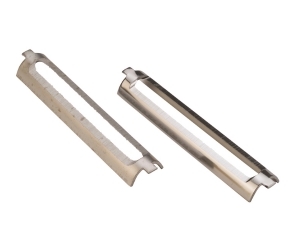
They may be microscopic, but the tiny jagged microburrs left behind on metal parts that have undergone machining processes can be big problems for manufacturers.
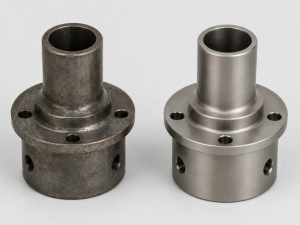
The extreme heat resistance and resilience characteristic of refractory metals like niobium, molybdenum, tungsten, tantalum and TZM make them useful in applications like aerospace components, small modular reactor components and other parts that must withstand extreme environments.
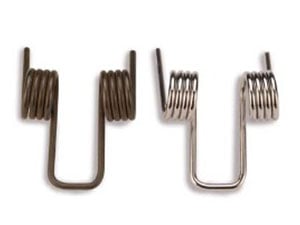
A wide array of modern assemblies for everything from aerospace parts to medical devices depend on high-quality springs that must perform to incredibly precise specifications, often in very tiny spaces.
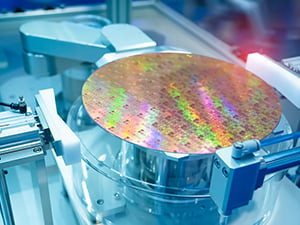
Electropolishing’s ability to remove a microscopically precise layer of surface material – with consistent and repeatable results – is a key reason it is so often specified as the final step in finishing metal parts for industries with no room for error.